What We Have Allowed Our Shared Life to Become: Applying Catholic Social Teaching to Contemporary Issues
Mass shootings in schools, bars, churches, grocery stores, and concerts now arrive with a grim familiarity. We grieve, we pray, we argue, and then we move on, because the news cycle moves on. Yet Catholic faith will not let us treat repeated bloodshed as normal. The Gospel refuses numbness. Catholic Social Teaching presses an uncomfortable question: not only what the shooter did, but what we have allowed our shared life to become.
 That shift in focus matters. If the problem is only the shooter, then the response stays private and reactive: condemnation, punishment, and perhaps a renewed call for personal moral formation. Those things have their place. But Catholic Social Teaching insists that personal sin and social sin intertwine. Human choices harden into patterns. Patterns become structures. Structures shape what a society tolerates and what it prevents.
So, the question becomes moral and civic at once. What kind of community are we forming when children practice lockdown drills as routinely as fire drills? What kind of society are we building when public gathering carries a quiet calculation of exits, hiding places, and worst-case scenarios? What has happened to the common good when ordinary spaces are shadowed by fear?
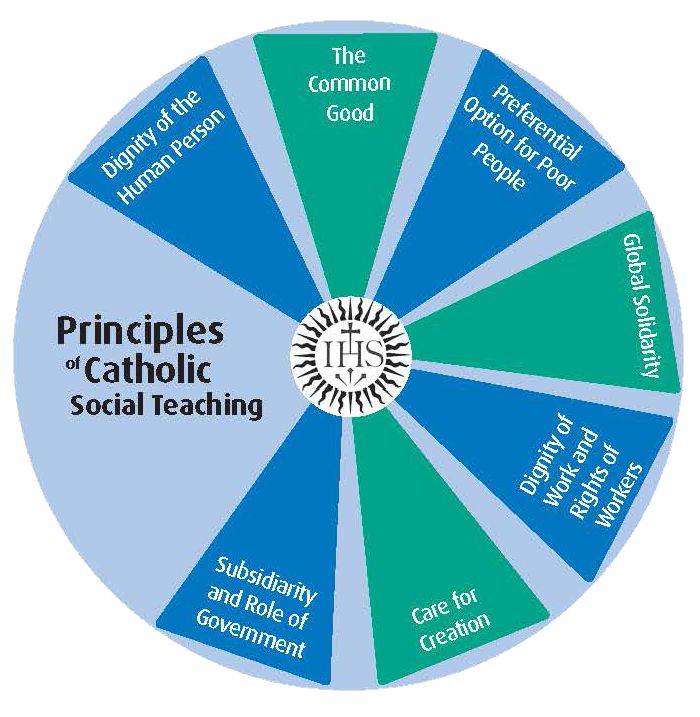
Catholic Social Teaching, as presented in the Compendium of the Social Doctrine of the Church (Compendium), begins with the life and dignity of the human person. This is not abstract language. It means every human life is a gift that may never be treated as disposable, collateral, or inevitable loss. When mass shootings become predictable, the temptation is to treat them like weather, tragic but unavoidable. A Catholic moral vision says no. If the loss of life is foreseeable, then preventing that loss becomes a responsibility, not merely an aspiration.
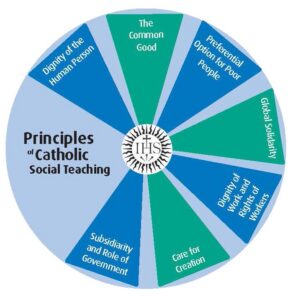 The tradition also speaks of rights and responsibilities. In Catholic teaching, public authority has a duty to safeguard peace and protect human life. That duty includes the hard work of crafting laws and policies that reduce foreseeable harm. Here, the Church refuses two simplifications at once. It does not say that violence is solved only by harsher punishment after-the-fact. Nor does it say that society is powerless before a market of weapons designed to magnify lethality. Catholic reasoning pushes us toward prudence: which concrete steps in fact protect life while respecting legitimate needs for safety and defense.
This is where the Church’s language of mercy becomes more than sentiment. Mercy is often imagined as private kindness, a warm feeling, a charitable gesture. But Catholic Social Teaching asks for mercy that takes public shape. It is mercy to accompany traumatized families and first responders, to fund counseling and long-term care, to stand with communities that cannot simply relocate away from danger. It is also mercy to pursue realistic reforms that make mass casualty events less likely and less deadly. Mercy is not only what we do after the wounds. Mercy is also what we do to keep our neighbors from being wounded.
 This is why the Church’s approach, including the work of the U.S. Conference of Catholic Bishops, often combines prayer and mourning with calls for specific measures that limit the capacity for rapid mass killing, improve accountability, and address root causes such as despair, social isolation, and a culture saturated with violent cues. In this view, law is not a substitute for virtue, but it is one way a society teaches itself what it will and will not accept. In their public statements, the bishops of the U.S. pair pastoral grief over mass shootings with appeals for concrete reforms, including limits on assault weapons and high-capacity magazines, universal background checks, and stronger anti-trafficking laws. (Bishop Chairmen Call for Congressional Action to Address Gun Violence | USCCB; Letter to Congress on Gun Violence, June 3, 2022 | USCCB; Gun Violence | USCCB).
The common good and solidarity clarify the point. Solidarity means we do not treat other people’s dead as the price of our comforts. We do not shrug when the vulnerable live with the highest risk. Schools, workplaces, and public venues are part of our shared moral ecosystem. If they become unsafe, the common good is wounded. If we refuse to act because the problem is politically difficult, solidarity erodes and fear wins.
 Catholic Social Teaching also highlights a preference for those most vulnerable. Children and teenagers do not choose the risks surrounding them. Workers in public-facing jobs often cannot avoid them. Communities already burdened by poverty or under-resourced services bear disproportionate costs when violence becomes routine. A pro-life ethic that speaks credibly must be willing to protect life where life is threatened, even when that protection requires political courage.
A Catholic response to mass shootings is not only about what the shooter did. It is about what we have allowed our shared life to become, and whether we will choose public actions that in fact make people safer, especially those most at risk. Prayer matters. Mourning matters. But Catholic faith also asks for conversion expressed in taking responsibility.
We should grieve. We should examine our hearts. And then we should insist, as a matter of the common good, that our public life be reordered toward safety, dignity, and peace. In Christian terms, that is not politics replacing faith. It is faith refusing to abandon the world God loves.
If you would like to make a comment or ask a question, I can be reached at dtheroux@smcvt.edu. Let’s talk!

For all press inquiries contact Elizabeth Murray, Associate Director of Communications at Saint Michael's College.
Related News See more news