Borders Are Real, But So Are Human Lives: Applying Catholic Social Teaching to Contemporary Issues
Pope Leo XIV (Tiziana Fabi/AFP/Getty Images)
Immigration debates in the U.S. often collapse into a single slogan: “secure the border.” Catholics can and should affirm that border governance is legitimate. The Church does not teach “open borders.” It recognizes the authority of governments to regulate entry for the sake of public order and the common good. Pope Leo XIV himself has explicitly affirmed that “every country has a right to determine who and how and when people enter” its territory (CatholicVote org; Bishop John C. Wester Statement, Archdiocese of Sante Fe).
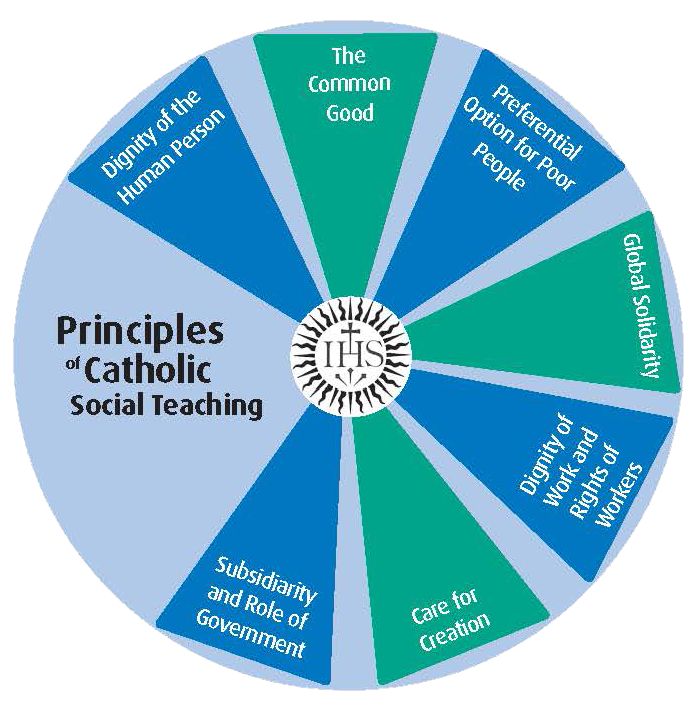
But Catholic moral teaching also insists on an equally firm principle: that authority is never absolute. It is bounded by the dignity of the person, the right to life, and the obligation of prosperous nations toward those who cannot find safety or the means of survival at home. The Catechism of the Catholic Church speaks in the language of obligation, not optional charity: “The more prosperous nations are obliged, to the extent they are able, to welcome the foreigner” seeking “security” and “the means of livelihood.” It adds a crucial line that is often overlooked in public debate: “Public authorities should see to it” that this natural right is respected (Catechism of the Catholic Church (CCC), 2241).
That last sentence matters because it brings us directly to a recent controversy. When Pope Leo XIV criticized the “extremely disrespectful” treatment of migrants in the U.S. and urged humane enforcement within a system of justice, he was not offering a partisan talking point. He was aligning himself with a rare “Special Message” from the U.S. bishops, who opposed “indiscriminate mass deportation,” condemned dehumanizing rhetoric, and urged a response rooted in human dignity (USCCB).

Mike Johnson, House Speaker (J. Scott Applewhite/AP)
House Speaker Mike Johnson responded by drawing a sharp distinction between personal morality and governmental responsibility. In remarks reported by Religion News Service, Johnson acknowledged biblical commands to “welcome the sojourner,” but argued the command is “an admonition to individuals, not to the civil authorities.” He then appealed to Romans 13 to describe civil authorities as “agents of wrath” charged with punishing wrongdoers, and he insisted that “sovereign borders are biblical and right” (Richmond Free Press; Religion News Service). A related report captured his core claim in shorthand: “Sovereign borders are biblical and right and they’re just … it’s not because we hate the people on the outside, it’s because we love the people on the inside. We should love our neighbors ourselves as individuals, but as a civil authority, the government has to maintain the law” (News of the United States).
This argument has rhetorical force because it sounds like prudence: individuals may be generous, while governments must be strict. Yet it conflicts with Catholic teaching at precisely the point where Catholic teaching is most explicit.
 First, the Church does not treat the political community as morally neutral. Government is not merely a traffic cop for law and order. In Catholic social doctrine, public authority is a real moral agent with responsibilities toward the common good, which includes protecting the vulnerable. That is why the Catechism of the Catholic Church places the duty to respect the migrant’s natural rights on “public authorities,” not only on private individuals (CCC, 2241).
Second, the bishops’ own immigration teaching is careful and balanced. “Strangers No Longer,” the joint pastoral letter of the U.S. and Mexican bishops, states plainly that while a sovereign state may control its borders, that right “is not absolute.” The needs of immigrants must be weighed against the needs of the receiving country, and policy must be shaped by human dignity rather than fear (USCCB).
Third, the bishops’ framework rejects the idea that a nation can claim total moral permission simply by invoking sovereignty. Their principles include the right not to migrate, the right to migrate when a dignified life is impossible at home, and the obligation of more prosperous nations to welcome those in need “to the extent they are able” (USCCB).
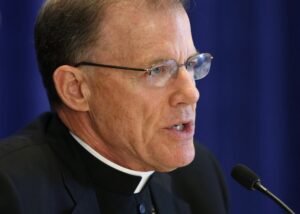
Archbishop John C. Wester, Archdiocese of Santa Fe (CNS photo/Bob Roller)
Archbishop John C. Wester of Santa Fe addressed the same point directly in response to Speaker Johnson. He affirmed that Catholic teaching does not advocate disorder or open borders, but he warned that it is “deeply troubling” when Scripture is used to diminish human dignity. He also rejected the attempt to reduce compassion for migrants to private virtue alone, calling that move “a fundamental misunderstanding of Christian ethics” (Archdiocese of Santa Fe).
A Catholic approach to immigration, then, is not “either borders or welcome.” It is borders ordered to justice. It is enforcement without cruelty. It is due process rather than indiscriminate measures. It is asylum for those who face grave harm, and real assistance for those whose lives are threatened by extreme deprivation, because the right to life precedes the convenience of any political system.
The question for Catholics is not whether a nation may regulate immigration. It may. The question is whether we will treat that power as an absolute, or whether we will govern it by the Gospel’s moral horizon: human beings are never “the problem” to be solved. They are persons to be protected, even when laws are enforced, because the law itself exists for justice (CCC, 2241).
If you would like to make a comment or ask a question, I can be reached at dtheroux@smcvt.edu. Let’s talk!

For all press inquiries contact Elizabeth Murray, Associate Director of Communications at Saint Michael's College.
Related News See more news